
Two thousand years ago, a few women walked to a borrowed tomb and found it empty. A handful of frightened disciples, hiding behind locked doors, encountered a man they had watched die. And something started.
What started wasn’t a religion. It was a reign. The risen Christ told his followers that all authority in heaven and on earth had been given to him, and then he sent them out to disciple the nations. Easter wasn’t a private miracle. It was a coronation.
That was the starting point. Here is what it looks like two thousand years later.
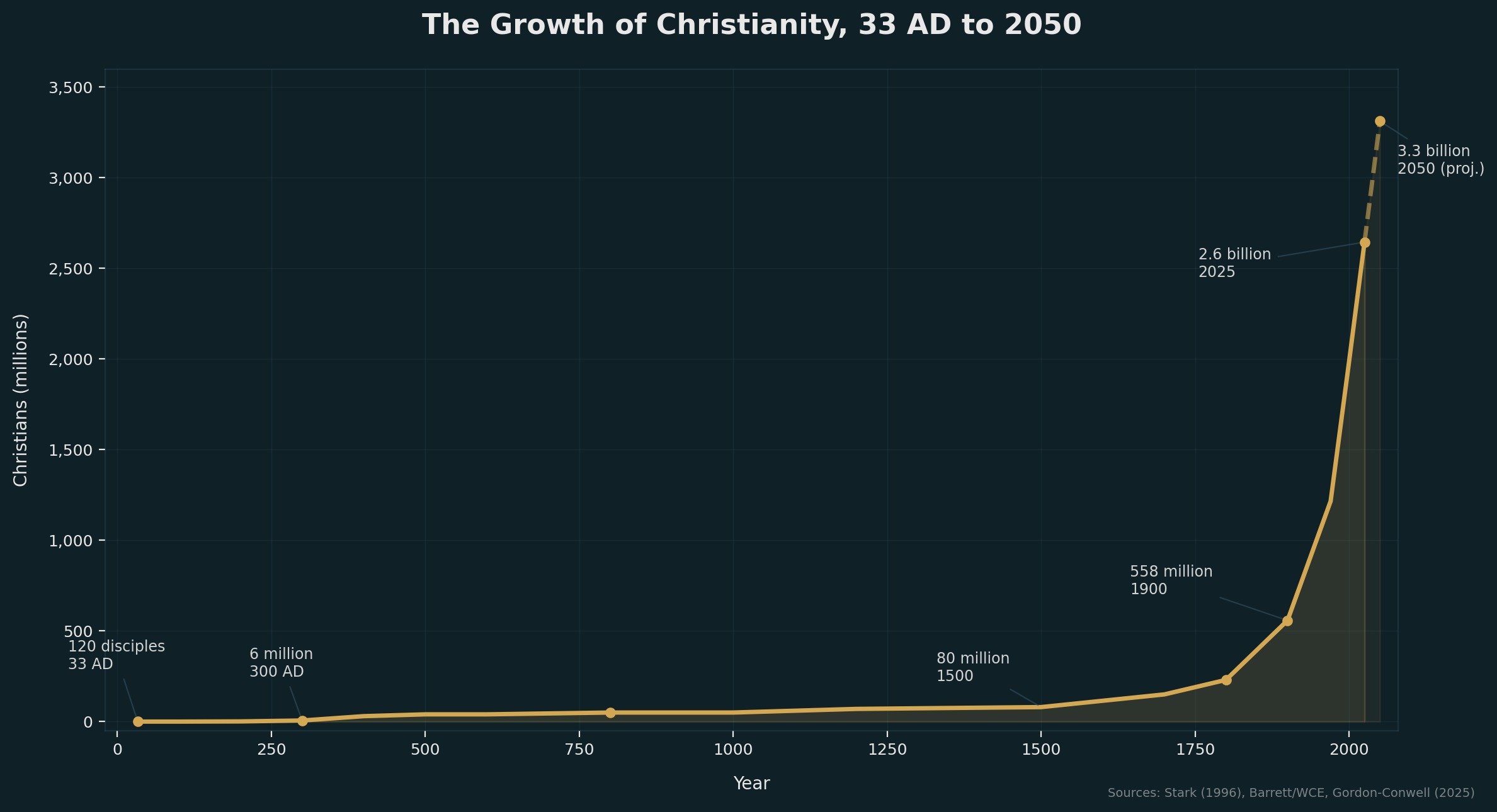
There are 2.64 billion Christians alive today.1
Let me say that again, because the number is so large it slides past without registering. Two billion, six hundred and forty-five million people confess Jesus Christ as Lord. One in three humans on the planet. More than at any point in history, by an enormous margin.
And the number is growing. Not shrinking. Growing faster than the world population itself.
If you’re a Western Christian, there’s a good chance you don’t believe that. The story you’ve absorbed from news coverage, from anxious pastors, from the general cultural mood, is that Christianity is dying. Church attendance is down. Young people are leaving. Secularism is winning. The faith had a good run but the Enlightenment finally caught up with it.
That story is true in one narrow geographic band. It badly misdescribes what is actually happening on the earth.
The Numbers
In 1900, there were 558 million Christians worldwide. Today there are 2.645 billion. By 2050, the projection is 3.3 billion.
Christians have held steady at roughly 32-34% of the global population for over a century, which means the faith has grown at least as fast as the human race itself across a period when the human race quintupled. That isn’t decline; the faith has kept pace across every continent, every language family, every political system.
But the raw growth number isn’t the real story. The real story is where that growth is happening.
The Great Reversal
In 1900, 82.4% of all Christians lived in Europe and North America. The Global South held 17.6%.
Today those numbers have almost exactly inverted. 68.9% of all Christians now live in Africa, Asia, Latin America, and Oceania. By 2050, it will be 78%.
Read that again. In the span of 125 years, Christianity has gone from a religion overwhelmingly concentrated in the West to one where more than two out of three believers live in the developing world. This is the most dramatic geographic shift in the history of any major religion, and most Western Christians have barely noticed it.
Philip Jenkins called it “the next Christendom” back in 2002.2 He was early. He was right.
Africa: The New Center of Gravity
Africa is where the scale changes.
In 1900, there were 9.6 million Christians on the entire African continent. Nine point six million, on a continent of 133 million people. Christianity was a coastal religion, mostly confined to Ethiopia’s ancient Orthodox communities and a scattering of mission outposts.
Today there are 754 million African Christians. By 2050, the projection is 1.29 billion.
Let me put that in perspective. Africa had fewer Christians in 1900 than the state of Ohio has people today. Now it has more Christians than any other continent on earth, having passed Latin America around 2018. The growth rate is 2.59% per year, nearly three times the global population growth rate.
Nigeria alone has over 90 million Christians.3 Ethiopia has over 70 million.4 The Democratic Republic of the Congo has over 60 million. These are not small outposts. In Lagos, megachurches seat 50,000 and plant daughter congregations that fill up within months. In Addis Ababa, the ancient liturgy of the Ethiopian Orthodox Church coexists with Pentecostal worship services that spill out of storefronts into the street.
Much of this growth is Pentecostal and Charismatic. In 1900, there were fewer than a million Pentecostals and Charismatics in the world. Today there are 664 million, roughly a quarter of all Christians on earth. The movement is largely indigenous, led by local pastors, funded by local communities, and spreading through networks that Western denominations often can’t see and don’t control.
The Rest of the World
Africa is the headline, but it’s not the whole story. There are 416 million Christians in Asia. China’s official churches report 44 million; researchers estimate the real number at 100 million or more.5 Mao’s government did everything a modern totalitarian state can do to eradicate religious belief. It failed. South Korea went from about 1% Christian in 1900 to roughly 28% today, and now sends missionaries to over 170 countries.67
In Iran, several hundred thousand to over a million people have converted from Islam to Christianity despite criminal penalties for apostasy.8 They worship in living rooms with curtains drawn, passing around smartphones loaded with Farsi Scripture. Getting caught can mean prison. The church keeps growing.
Latin America has 620 million Christians. Evangelical Protestantism has surged from 5% of Brazil’s population in 1970 to 27% per the 2022 census.9 In Guatemala, it’s over 40%.10
Western Decline: Honest Accounting
Now the part that actually matches the narrative Western Christians have internalized.
Europe had 381 million Christians in 1900. Today it has 552 million, but the number peaked around 2000 and has been declining since. The trend rate is -0.54% per year. By 2050, Europe is projected to have 474 million Christians, which would be fewer than it had in 1970.
North America tells a softer version of the same story. Christian population peaked around 2020 and is now declining at -0.14% per year. By 2050, the projection is 256 million, down from 272 million today.
I’m not going to sugarcoat this. The decline in the West is real and it matters. These are communities I belong to. The PCA church I serve as an elder, the broader Reformed and Evangelical ecosystem in America, the ancient churches of Europe: they face genuine challenges. Young people are leaving. Cultural Christianity, the kind where you’re Christian because your parents were and your town expected it, is evaporating. What remains is being distilled down to people who actually believe it.
Whether that distillation is entirely bad is a question worth sitting with.

The Great Commission Is Working
The New Testament has been translated into 2,500 languages, up from 228 in 1900. There are 450,000 cross-cultural missionaries serving worldwide, and the missionary force has globalized: Brazilians in North Africa, Koreans in Central Asia, Nigerians in London.
The Western church’s decline is real, and those of us who live in it should take it seriously. But mistaking the West for the whole is a kind of theological provincialism. Christianity does not depend on Europe. It never did. The faith was Middle Eastern and North African before it was European, and it is becoming African, Asian, and Latin American now.
I don’t know why the Gospel is exploding in Lagos and struggling in London. I don’t know what the Church in China will look like in 2050. I won’t pretend to have a clean explanation for every data point.
But Psalm 110, the most-quoted Old Testament passage in the New Testament, records the Father’s word to the risen Son: “Sit at my right hand, until I make your enemies your footstool.” Paul wrote that Christ must reign until he has put all his enemies under his feet (1 Cor. 15:25). The New Testament writers understood this as already happening. Not waiting. Happening.
N.T. Wright put it this way: “The message of the resurrection is that this world matters. Easter means that in a world where injustice, violence and degradation are endemic, God is not prepared to tolerate such things, and that we will work and plan, with all the energy of God, to implement the victory of Jesus over them all.”
He is risen. And his Kingdom advances on all fronts.