In 1820, roughly 84% of human beings lived in what we would now classify as extreme poverty.1 Not 84% of some specific country or region. Eighty-four percent of everyone alive.
Today it’s about 10%.2
That single fact should change how you think about the world. It should change how you read the news, how you interpret history, and if you’re a Christian, how you think about what God is doing. But most people have never heard it, and many who have don’t believe it.
I want to walk through how it happened, why it matters, and what it means.
What “Extreme Poverty” Actually Means
The World Bank defines extreme poverty as living on less than $3.00 per person per day, measured in 2021 purchasing power parity dollars.3 (This line was updated in June 2025 from the previous $2.15/day threshold in 2017 PPP. The real purchasing power it represents hasn’t changed meaningfully; it’s the same basket of goods repriced in newer dollars.4)
Three dollars a day means you cannot reliably feed yourself. It means no electricity, no clean water, no medical care beyond what you can find growing wild. It means your children are visibly malnourished and you watch some of them die. It means a toothache can become a life-threatening infection.
This is not “relative poverty,” where you have less than your neighbors. This is absolute material deprivation. Caloric survival is uncertain. Shelter is improvised. Death from exposure or preventable disease is a constant background possibility.
And for most of human history, this was normal.
The Flat Line
Here is what almost nobody appreciates about the human past: for thousands of years, material conditions barely changed.
A Roman farmer in 100 AD and an English farmer in 1700 AD lived in conditions that were, by most material measures, remarkably similar. Both ate grain-based diets supplemented by whatever they could grow or keep. Both lived in structures that offered minimal protection from cold. Both buried multiple children. Both faced child mortality rates that pulled life expectancy at birth far below modern levels. Both could expect to spend their entire lives within a few miles of where they were born.
The average person in 1800 lived roughly the way the average person in 800 had lived. Or in 200 BC. The technologies changed at the margins. But the basic facts of human material existence were stuck.
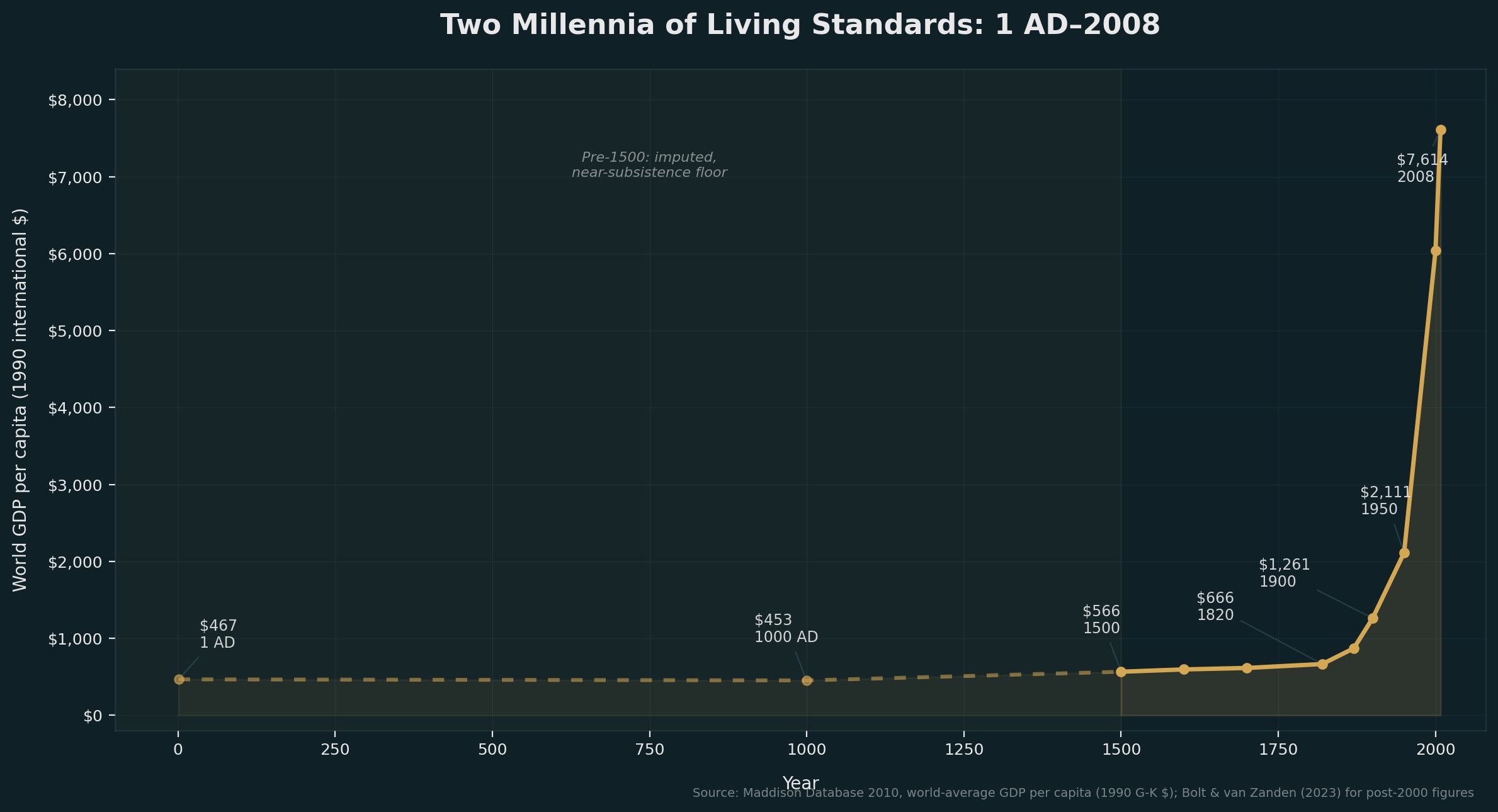
Then the line bent.
The Hockey Stick
Starting around 1820, something unprecedented happened. For the first time in recorded history, the share of humans living in extreme poverty began to fall. Slowly at first. Then faster. Then very fast.
The numbers, drawn from Bourguignon and Morrisson’s reconstruction of historical income distributions and extended by the World Bank’s modern surveys:15
- 1820: ~84% in extreme poverty
- 1910: ~66%
- 1950: ~55%
- 1981: ~44%
- 2000: ~28%
- 2015: ~11%
- 2024: ~10.4%
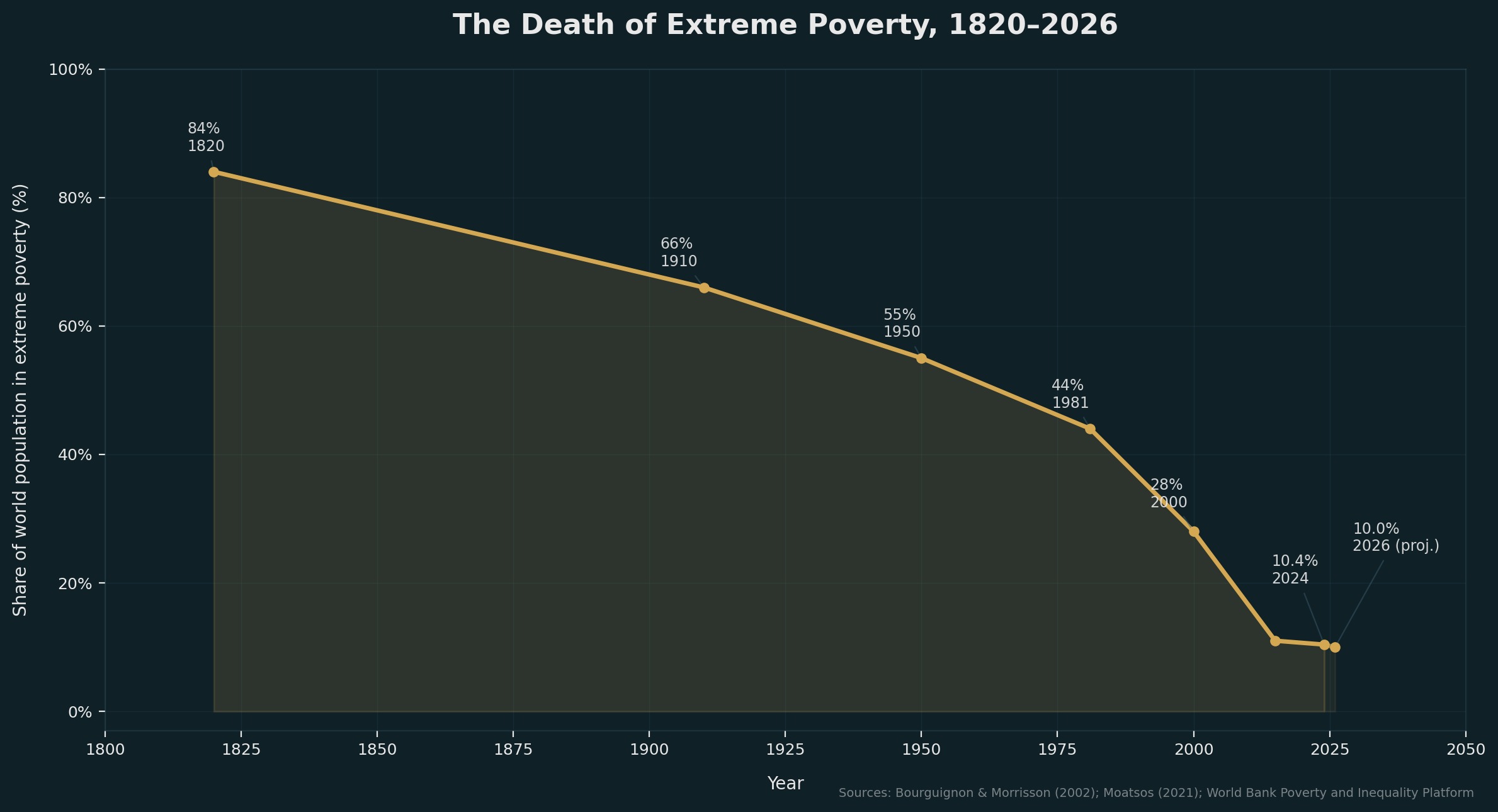
Read that sequence again. For millennia, the number was stuck near the top. Then in two centuries, it fell by almost 75 percentage points. Nothing like this has happened before. No precedent in any civilization or era.
As of 2024, the World Bank estimates that 847 million people still live in extreme poverty.2 That is 847 million too many. But out of a global population exceeding 8 billion, it represents a share that would have been inconceivable to anyone alive in 1900.
What Changed?
There’s no single cause. Anyone who tells you “capitalism did it” or “technology did it” or “colonialism ended and everything got better” is selling you a bumper sticker. The real story involves at least four interlocking forces.
Economic growth and trade. When countries grow economically and participate in international trade, poverty falls. This is not a contested claim among development economists. The mechanisms are straightforward: trade creates specialization, specialization increases productivity, productivity increases wages. The Asian Development Bank identifies trade-driven growth as one of the most important drivers of poverty reduction in the Asia-Pacific region.6
Technology. The Green Revolution alone may have saved a billion lives. Norman Borlaug’s dwarf wheat varieties, introduced across Mexico, India, and Pakistan in the 1960s and 70s, roughly doubled cereal yields in countries where famine had been a recurring fact of life.7 Vaccines, antibiotics, water purification, synthetic fertilizers: the sheer accumulation of applied knowledge created material conditions our ancestors could not have imagined.
Institutional reform. Property rights, rule of law, functioning courts, contracts that mean something. The countries that have exited extreme poverty most decisively are the ones that built institutions allowing ordinary people to own things, start businesses, and resolve disputes without resorting to violence or bribery. Where these institutions are absent or broken, poverty persists.
Something harder to name. There is a cultural substrate underneath all of this that rarely gets credit. The idea that every human life has dignity. The idea that the poor should be helped rather than ignored. The conviction that suffering is not simply fate but a problem to be solved.
These ideas are not universal. They are historically unusual. And they have identifiable roots.
The Christian Thread
I want to be careful here, because triumphalist claims about Christianity and economic development can get sloppy fast. But certain facts are worth stating plainly.
The first hospitals in the Roman world were Christian institutions.8 The first widespread literacy campaigns in most of sub-Saharan Africa were mission schools.9 The abolition of the Atlantic slave trade was driven overwhelmingly by evangelical Christians, led by William Wilberforce and the Clapham Sect, who fought for decades against ferocious economic interests.10 The concept of universal human dignity that undergirds modern human rights discourse is, historically, a Christian invention. Tom Holland’s Dominion traces this lineage in exhaustive, sometimes uncomfortable detail.11
None of this means that Christianity automatically produces economic growth, or that Christians have always been on the right side. They obviously haven’t. But the cultural operating system that made poverty reduction conceivable as a moral project has deep roots in the conviction that every person bears the image of God.
The Regional Stories
The global number is dramatic. The regional stories are where it gets real.
East Asia: The Greatest Exit
In 1990, East Asia and the Pacific was home to 53% of the world’s extreme poor, more than a billion people.12 By 2022, that figure had collapsed to 4%, roughly 29 million people.12
China accounts for the bulk of this. Between 1981 and 2015, close to 800 million Chinese citizens crossed the extreme poverty line, as the national poverty rate collapsed from 88% to 0.7%.13 Whatever you think about the Chinese government (and there is plenty to criticize), this is the largest and fastest poverty reduction for a single country in human history.
South Korea tells a different version of the same story. In 1961, South Korea’s GDP per capita was about $94 in current dollars.14 As late as 1965, more than 40% of South Koreans lived in absolute poverty.14 Today it’s one of the world’s most advanced economies, with a GDP per capita above $35,000. The transformation took a single lifetime.
India: The Quiet Revolution
India’s progress gets less attention than China’s, partly because it started later and partly because the country’s size makes every problem look enormous. But the numbers speak clearly.
India’s extreme poverty rate fell from 16.2% in 2011-12 to 2.3% in 2022-23, as measured by the pre-2025 $2.15/day line.15 That’s 171 million people crossing the threshold in roughly a decade. Rural poverty fell from 18.4% to 2.8%. This happened through a combination of economic growth and aggressive government transfer programs for food and direct cash payments.
India still has large numbers of people living just above the poverty line. One bad shock could push millions back under. But the trajectory is clear.
Sub-Saharan Africa: The Remaining Frontier
Here the story gets harder.
Sub-Saharan Africa had an extreme poverty rate of 46% in 2024.2 The region accounts for 16% of the world’s population but 67% of the world’s extreme poor. The absolute number of people in extreme poverty in the region has nearly doubled since 1990, rising from about 321 million to roughly 582 million in 2024, even as rates have declined somewhat.16 Population growth has outrun poverty reduction.
GDP per capita in sub-Saharan Africa grew by only 0.7% per year between 1990 and 2022, compared to 1.6% globally.16 Conflict, institutional weakness, the legacy of colonial extraction, and (frankly) ongoing corruption and misgovernance have all played roles.
But I refuse to tell this story as if Africa is hopeless. The poverty rate has declined. Several countries, including Ethiopia, Rwanda, and Tanzania, achieved dramatic reductions before recent instability in some cases reversed gains. Mobile banking (M-Pesa in Kenya), expanding education, and a growing African middle class are real. The story is not over. It is slower than we want, and it demands honesty about the obstacles, but writing off an entire continent is intellectually lazy.
The COVID Reversal (and Recovery)
COVID-19 pushed an estimated 88 to 115 million additional people into extreme poverty in 2020.17 It was the first increase in global extreme poverty in over two decades. Supply chains broke. Informal workers lost everything overnight. Countries without safety nets watched their poorest citizens fall through the floor.
The good news: by 2024, the global rate had largely recovered to its pre-pandemic trajectory, though the pandemic’s impact lingered in specific regions, particularly the Middle East and parts of South Asia.2 The World Bank projects global extreme poverty falling to 10.0% by 2026.2
The pandemic was a real setback. It was not a permanent reversal. The trendline reasserted itself.
The Objections
Two serious objections deserve honest engagement.
“The poverty line is too low”
This is the most common critique, and it has some force. $3.00 a day is desperately poor. Someone living on $3.50 a day has technically “escaped” extreme poverty but is still desperately poor. Critics like Jason Hickel have argued that using a higher poverty line ($7.40/day, the so-called “ethical poverty line”) reveals far less progress.18
Fair enough. The higher you set the bar, the more people fall below it. But this critique, taken seriously, actually strengthens the case for economic growth, because moving people from $1 to $3 is meaningful, and moving them from $3 to $10 requires the same forces (growth, trade, institutions) operating over a longer period. The extreme poverty line is the starting gate, not the finish line.
And the claim that no progress has been made at higher thresholds is simply false. The World Bank’s $6.85/day line (the upper-middle-income threshold) shows global poverty falling from 69% in 1990 to 44% in 2024.19 Progress is real across every threshold; it’s just sharpest at the bottom.
“This is all just China”
A more sophisticated objection: strip out China and the picture looks less impressive. And it’s true that China accounts for a disproportionate share of global poverty reduction since 1980.
But “strip out China” is a strange analytical move. China contains 1.4 billion people. You can’t just subtract a fifth of the human race to make a point. India’s recent progress, Indonesia’s transformation, Bangladesh’s garment-industry-driven growth, Vietnam’s rise from one of the world’s poorest countries to a middle-income economy: these happened independently of China. East Asia’s success runs on multiple independent engines.

What This Means for Christians
Here is the theological claim I want to make, and I’ll state it as directly as I can: the lifting of billions out of extreme poverty is Kingdom work. Whether or not the people doing it know it.
When Jesus inaugurated His ministry in Luke 4, He quoted Isaiah: “The Spirit of the Lord is upon me, because he has anointed me to proclaim good news to the poor.” This was not metaphor. The poor hearing good news, the oppressed going free, the broken being restored: this is what the Kingdom looks like on the ground.
The Christian conviction is that Christ is reigning now, at the right hand of the Father, and “he must reign until he has put all his enemies under his feet” (1 Cor. 15:25). Poverty is an enemy. Disease is an enemy. Hunger is an enemy. And they are losing.
I am not saying that economic development is the Gospel. The Gospel is the announcement that Jesus Christ is Lord, that He died and rose, and that through faith in Him we are reconciled to God. Development without that announcement is incomplete.
But I am saying that when the Gospel enters a culture, it brings with it seeds that grow into institutions, habits, and convictions that, over time, produce material flourishing. Literacy campaigns born in mission schools. Hospitals born from the conviction that the sick deserve care. Legal systems rooted in the idea that every person, including the poor, has standing before the law.
Two thousand years ago, a carpenter from Nazareth told a parable about a mustard seed. The smallest of seeds, He said, grows into the largest of garden plants. The birds of the air come and nest in its branches.
Look at the data. The tree is growing.
847 million people still live in extreme poverty. That is the work that remains. It is real, and it is urgent, and it demands more from us, not less.
But the trajectory is not ambiguous. The line keeps bending.
His Kingdom advances on all fronts.