Last year in Canada, 16,499 people died by medical assistance, up from 1,018 in 2016, the first year it was legal. That’s 5.1% of all deaths in the country.1 One in twenty. The eligibility criteria have expanded steadily, from terminal illness to chronic conditions to, in legislation scheduled to take effect in March 2027, mental illness alone. The language of the debate shifted accordingly. “Dying with dignity” replaced “killing.” “Self-determination” replaced what prior civilizations called sacrilege.
The policy changed, certainly, but what drove it, allowed it and now condones it? It was the frame. Death used to be sacred, a threshold no human hand could rightly cross. Now it’s a service you can book.
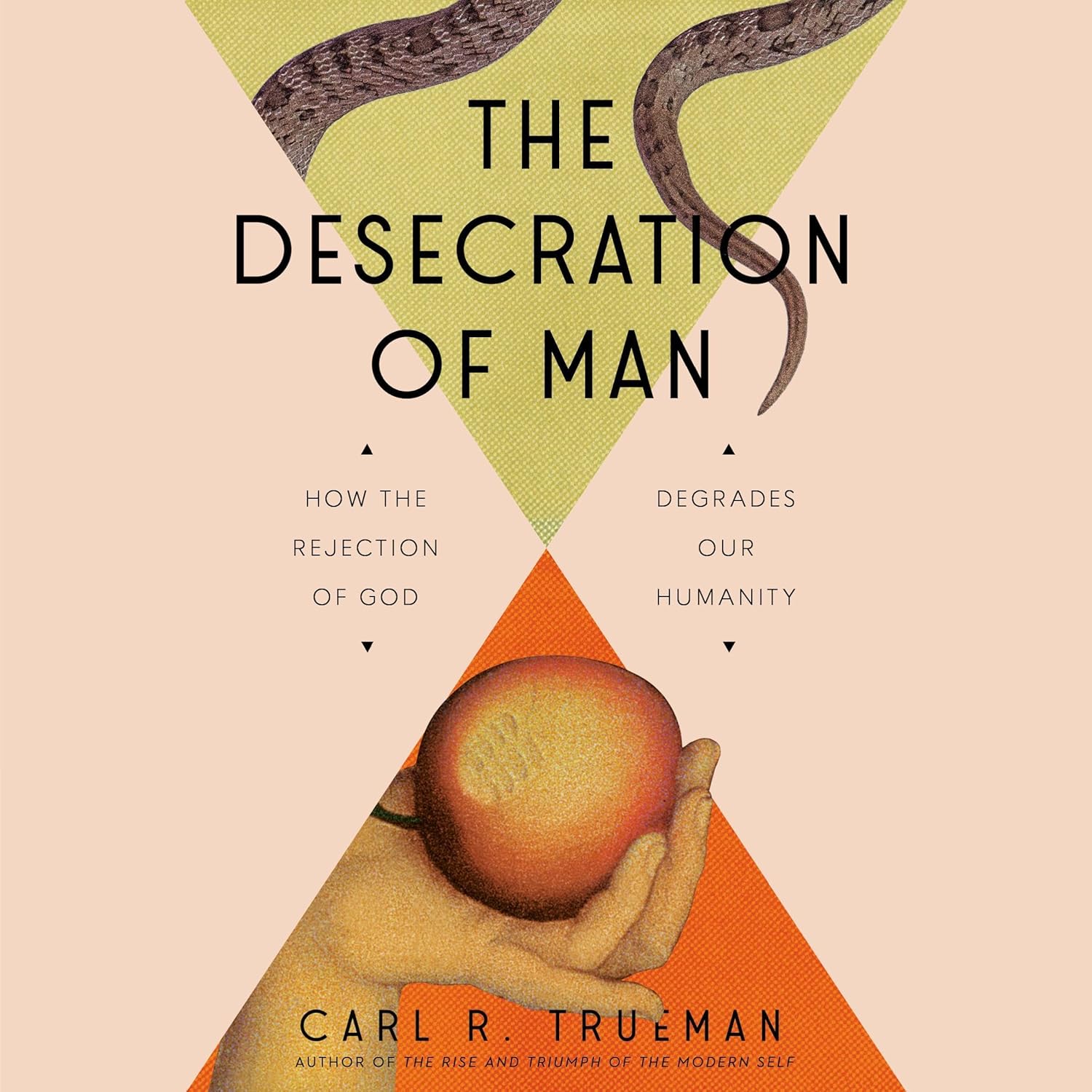
Carl Trueman’s explanation goes deeper than the usual conservative lament about declining values or cultural drift. In The Desecration of Man: How the Rejection of God Degrades Our Humanity (Sentinel, 2026), the Grove City College historian and author of The Rise and Triumph of the Modern Self argues that modernity hasn’t merely disenchanted the world, draining it of mystery and meaning the way Max Weber and Charles Taylor described.2 It has desecrated it. Profaned it. Taken what was holy and deliberately trampled it. And there is a movement in this culture that doesn’t just tolerate this trampling; it finds it thrilling.
The Argument
Trueman’s thesis follows a single logical chain. If human beings are made in the image of God, then killing God first will profane His image-bearers. The death of God, announced by Nietzsche and ratified by the twentieth century, didn’t leave humanity untouched. It stripped humans of whatever made them sacred. Therefore, the “desecration” in the title is not a metaphor but Trueman’s precise, technical claim: modernity has done to the human person what iconoclasts did to altars: smashed the image because it hated the God behind it.3
Trueman argues that this happens along three dimensions.
First, the denial of human exceptionalism. Darwin placed humans on a continuum with animals. Peter Singer drew the logical conclusion that if there is no ontological distinction between a human and a great ape, then “speciesism” is just another prejudice, like racism or sexism.4 Trueman is careful here. He doesn’t dismiss evolutionary biology. He asks what happens to human dignity when the metaphysical foundation for it is removed. If you are not an image-bearer of God, what exactly makes you more valuable than a well-trained border collie? Singer, to his credit, admits the answer is: nothing. Most people are not so honest.
Second, the objectification of persons. Pornography is Trueman’s primary case study, though he extends the analysis to surrogacy and commodified reproduction.5 The common thread is reduction. A person becomes a body. A body becomes a product. A product becomes disposable. You have probably heard this argument before. Trueman’s version is sharper than most because he does not stop at “objectification is wrong” (which everyone already agrees with, at least in the abstract). He asks why it’s wrong, and that answer depends entirely on what kind of thing a human being is.
Third, the replacement of given ends with self-creation. Trueman sees transhumanism and the transgender movement as expressions of the same impulse: the refusal to accept any unchosen limit on the self.6 If there is no Creator who made you for something, then you are raw material, and the only question is what you will make of yourself. The body is not a gift to be received. It is a project to be managed.
Here, we see Trueman’s Nietzsche thread become essential. Friedrich Nietzsche, the nineteenth-century German philosopher who declared “God is dead,” saw something that most of his contemporaries missed. You cannot kill God and keep the moral furniture He left behind.7 The dignity of the individual, the equality of persons, the conviction that the weak deserve protection: all of these are Christian principles, running on Christian metaphysics. Kick out the metaphysics and the morality doesn’t float in midair. It crashes. Nietzsche’s point was not that this crash was tragic. His point was that it was liberating. Those who kill God must become gods themselves!
While Trueman agrees with Nietzsche’s logic, he differs drastically about the liberation. He thinks the contemporary West is living in the wreckage of exactly this collapse, borrowing Christian moral vocabulary (“dignity,” “rights,” “justice”) while having abandoned the only worldview that can underwrite those words.
Sex and Death
The book’s strongest chapters use sex and death as twin case studies. Both, Trueman observes, were sacred in virtually every pre-modern culture. Not sacred in a vaguely spiritual sense but rather ritually bounded and hedged with laws and customs and taboos. Every known civilization surrounded sexual union and the moment of death with ceremony, prohibition, and awe.8
The sexual revolution, on Trueman’s reading, was not primarily about freedom. It was about desacralization. To strip sex of its sacred character, its connection to covenant, fertility, and the mystery of two becoming one, was to make it available for consumption. And consumption is exactly what followed. Trueman traces this from contraception, to the mainstreaming of pornography, to the current debates over sex work, while reading each as a further step in the same process: taking what was holy and making it ordinary, then making it commercial, then making it trivial.9
Death follows the same arc. Euthanasia and assisted suicide don’t merely raise ethical questions about autonomy and suffering. They represent the desacralization of the last threshold. For Trueman, when a society treats death as a routine medical procedure, it hasn’t expanded human freedom. It has shrunk the human person to the size of a consumer choice.10
The Canada statistics bear repeating. In eight years, medically assisted deaths rose from 1,018 to 16,499. The categories of eligibility have expanded steadily, from terminal illness to chronic conditions to, in legislation scheduled to take effect in March 2027, mental illness alone. Trueman sees this not as a slippery slope (a phrase that implies accident) but as the internal logic of desecration working itself out. Once the sacred boundary is breached, there is no secular principle that can reestablish it.
Three Inadequate Responses
Trueman’s final movement of the book examines three attempts to solve the problem without the full resources of Christianity. Trueman is at his sharpest here, and at his most entertaining.
Richard Dawkins’s cultural Christianity. In a move that would have amused Nietzsche enormously, the world’s most famous atheist was by 2024 openly calling himself a “cultural Christian.”11 Dawkins wants the ethics, the architecture, the Christmas carols. He wants the code without the creed. Trueman’s response is blunt: this is exactly the parasitism Nietzsche diagnosed. You can admire the flowers, but you’ve poisoned the roots. It works for a generation, maybe two. Then the flowers die.
Roger Scruton’s aesthetic Christianity. The late philosopher Roger Scruton offered a more sophisticated version: Christianity as the highest expression of Western civilization’s sense of the sacred, valuable for its beauty, its art, its capacity to consecrate ordinary life.12 Trueman is gentler with Scruton, whom he clearly admires. But the objection is the same. Scruton wants the cult (the liturgical and aesthetic dimension) without full commitment to the creed (the truth claims). Beauty without belief is nostalgia. And nostalgia cannot consecrate anything.
Hypocritical Christianity. Trueman turns the knife inward. Christians who hold the creed and practice the cult but ignore the code, who confess the sanctity of life on Sunday and consume pornography on Monday, who affirm human dignity in their theology and deny it in their economic practices, are a third kind of failure.13 They have the pieces but refuse to assemble them.
Trueman’s prescription is the full package: creed, cult, and code, held together in the life of the worshipping church. Only communities that confess the truth about God (creed), practice worship and sacrament (cult), and live out the ethical implications (code) can reconsecrate what modernity has profaned. “Hard as it is, there is no third way between Christianity and Nietzsche, between Christ and the Madman,” he concludes. “Either we have our creed, our cult, and our code, or we have none of them.”14
Where the Camera Stops
This is, by any measure, a brilliant diagnosis. Trueman writes with the precision of a historian and the force of a prosecutor building a case. The Nietzsche thread alone is worth the price of the book. The refusal to let Christians off the hook, the insistence that creed without code is its own form of desecration, gives the argument a moral seriousness that most culture-war polemics lack. I can think of few books that explain the logic of our cultural moment with this much clarity.
But I want to raise a question Trueman doesn’t ask.
If consecration is the answer, is it actually happening?
Trueman frames consecration as a prescription. The worshipping church must do this. We need to recover that. His gaze is fixed on the West, on Amsterdam and Austin and the campuses of the Ivy League. And within that frame, his pessimism is understandable. The trends he describes are real. Assisted suicide is expanding. Pornography consumption is epidemic. The philosophical coherence of secular humanism is collapsing under the weight of its own contradictions.
But the West is not the world. And the church is not a Western institution.
There are roughly 2.6 billion Christians on the planet today, and the majority of them live in Africa, Asia, and Latin America.15 The Center for the Study of Global Christianity projects that by 2050, Africa alone will be home to 1.29 billion Christians, more than the entire current population of Europe.16 The growth is not merely numerical. It is exactly the kind of consecration Trueman prescribes: communities of creed, cult, and code, confessing the faith, worshipping together, and living out its ethical implications in contexts of poverty, persecution, and cultural transformation.
Consider just one case. In 1979, Iran had a few thousand Muslim-background believers, alongside a larger ethnic Armenian and Assyrian Christian minority. Then the Islamic Revolution made conversion a criminal offense, and something perverse happened: the church started growing. Today, researchers estimate hundreds of thousands of Iranian believers worshipping in living rooms with curtains drawn and passing around smartphones loaded with Farsi Scripture, with some estimates exceeding one million.17 Getting baptized can mean prison. They get baptized anyway. This is not a footnote to the story of global Christianity.
These are not peripheral developments. They are the main story of global Christianity in the twenty-first century. And they are, in Trueman’s own terms, acts of consecration. When an Iranian woman risks her freedom to be baptized in a living room in Tehran, she is doing precisely what Trueman says must be done. She is declaring, with her body, that human beings are sacred because they bear the image of a holy God. She is reconsecrating what the powers of this age have tried to profane.
Trueman might respond that the Global South church has its own problems, its own compromises, its own failures of code. That’s true. No church on earth fully embodies the creed-cult-code synthesis he describes. But the question is one of trajectory. Is the world getting more desecrated or less? Is the worshipping church growing or shrinking? Are more people, in more places, confessing that human beings are image-bearers of God?
The answer to all three questions, on the global scale, is encouraging. And it seems strange to write a book about the desecration of man without noticing that the largest consecration movement the church has ever seen is happening simultaneously.
The Nietzsche Wager
Trueman ends with Nietzsche’s challenge: there is no third way. Either the Christian account of the human person is true, or we are left with the will to power. I think he’s right about that. The middle options, the cultural Christians and aesthetic Christians and inconsistent Christians, are all unstable. They borrow from a capital they refuse to replenish.
But here is the thing about a wager with only two options. If one side is winning, you should notice.
Paul told the Colossians that Christ’s project is to reconcile all things to himself, “making peace by the blood of his cross” (Colossians 1:20). Not some things. All things. Not escaping the desecrated world, but reconsecrating it.
Trueman has written the sharpest Christian account of desecration I have read. The diagnosis is precise, the logic holds, and the prescription is correct. What’s missing is the prognosis. Consecration is not merely something the church ought to attempt. It is something Christ is accomplishing, through His Spirit, in every corner of the world, often in the very places where the darkness looks most complete.
Earlier this month on the White Horse Inn, Michael Horton and Bob Hiller sat down with Magnus Persson, a Swedish pastor, for an episode titled “Secularism Is Dying. What’s Next.” Persson came with a report from Sweden, a country that has practiced secularism longer and more thoroughly than any other in the West. His diagnosis sounded a lot like Trueman’s: a culture is unable to give its people meaning, identity, or a floor under their moral intuitions. But his prognosis was not Trueman’s. “Many people are looking for stability,” Persson told Horton, “relocating the center of where gracious God be found, exhausted by the chase of new highs and feelings and experiences inside the chambers of the hearts. The era of subjective beliefs and subjective experiences is gone, and you’re looking for objective anchors for the faith.” He described a confessional resurgence not just in Sweden but “all over the world,” a return to creeds and sacraments and the seven marks Luther once listed for a church trying to remember what it was.18
Two months earlier, on the same podcast, Horton sat across from Ben Sasse who seven weeks earlier had been diagnosed with stage 4 pancreatic cancer. They worked through Philippians 1:21 and 1 Corinthians 15 and the old practice of walking through a graveyard on the way into the sanctuary, so the dead met you before the Lord’s Supper did. “To live is Christ, to die is gain,” Sasse said. “We felt amazingly blessed that Melissa and I immediately were at peace about all this.”19 “Death is the last enemy we will ever have,” Horton answered. “Last is pretty great.” That exchange, between a dying man and his old friend, is the sound of death being reconsecrated. Not by policy. By confession.
This is what reconsecration looks like under way. Creed, cult, and code coming back into view in the very places where the sociologists thought they had finally died. One life, one confession at a time, something holy is being restored.