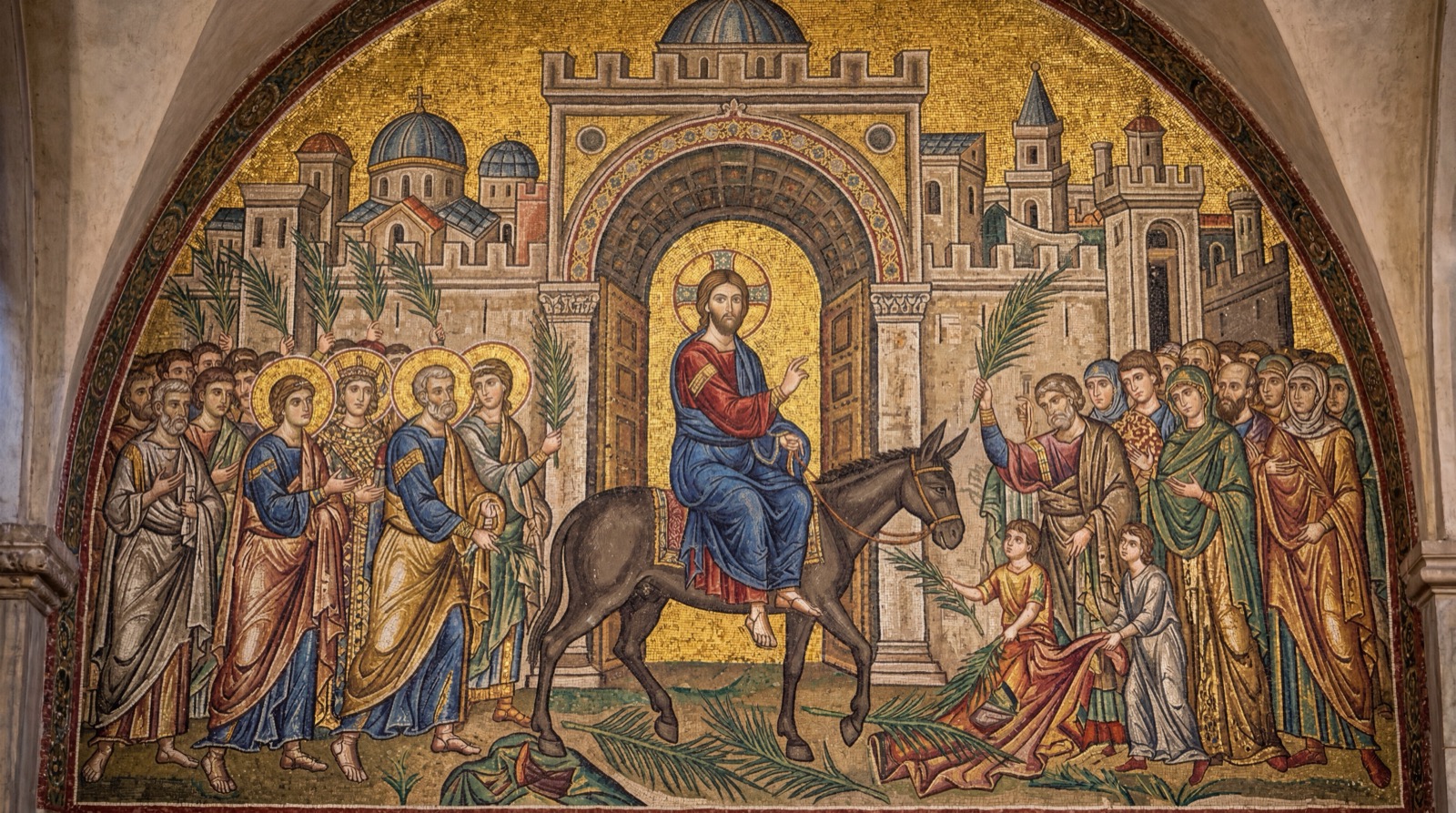
This Sunday, churches around the world will wave palm branches and shout Hosanna as they read the story of a King riding into His capital city. It’s one of the most familiar scenes in Scripture, and one of the most misunderstood. We read it as the prelude to the Passion. A brief moment of triumph before the real story begins.
But N.T. Wright argues that the triumphal entry is a glimpse of something much larger: the climax of a promise that runs from Genesis to Revelation. God himself returning to dwell with His creation. The entry into Jerusalem is one scene in that story. The incarnation, the cross, the resurrection, the coming of the Spirit. All of it is the homecoming. And it’s still happening.
God’s Homecoming: The Forgotten Promise of Future Renewal (2026) is the book Wright has been building toward for two decades.1 It picks up where Surprised by Hope left off and addresses the deeper assumption that book didn’t fully dismantle: the idea that Jesus only really becomes Lord when He finally returns, and that everything before that is just preparation.
The opening line: “The point of Christianity is not that we should go to heaven. The point of Christianity is that heaven should come to us.”2
Ask the average Christian what the faith is about, and most will give you some version of: believe in Jesus, live a good life, go to heaven when you die. It’s in the hymns. It’s in the funeral sermons. Wright thinks it’s wrong, and he’s spent a career saying so. But this book does something his earlier work didn’t quite manage. It shows that the alternative isn’t just theologically correct. It’s better news.
The Argument
Wright identifies two interlocking promises running through Scripture. The first is cosmic: God’s intention to fill all creation with His glory (Habakkuk 2:14, Isaiah 11:9, Psalm 33:5).3 The second is covenantal: YHWH’s personal promise to return to Zion after exile (Isaiah 40, 52:7–10, Ezekiel 43).4
These two threads converge in the incarnation. When John writes that “the Word became flesh and dwelt among us” (John 1:14), the Greek literally means “tabernacled,” pitched His tent, moved in.5 Jesus is the new temple. God has come home.
But the homecoming doesn’t stop at the incarnation. Wright’s crucial move comes in chapter 7, where he argues that the Spirit’s filling of the church is the anticipation of the final filling of all creation with divine glory. Paul retells the Exodus story with the Spirit playing the role of the divine glory in the tabernacle, leading God’s people not to heaven, but to their inheritance, which for Paul is “the whole world” (Romans 4:13).6
The structure of the book unfolds in three movements. Chapters 1–7 trace the biblical narrative from Genesis through the Spirit. Chapters 8–10 form an interlude examining how the Western tradition replaced the biblical story with Platonic escapism. And chapters 11–14 draw out the implications for worship, sacraments, church unity, and the question of life after death.7
What Wright Gets Right
The direction is downward, not upward. This is the book’s most important contribution, and it’s worth dwelling on. Wright: “The story the early Christians told was not about how humans (or their souls) could, as it were, go upstairs into the presence of God. It was about how God had come downstairs to live with them, and would one day complete that operation, eventually suffusing all creation with his glorious presence.”8
Think about what this means practically. If the direction of the story is upward, then every hospital you build, every child you raise, every law you write is for a world that’s going to burn. That’s not a straw man. Christians say this. “Why polish brass on a sinking ship?” But if the direction is downward, if God is coming here, then faithfulness in culture, in work, in family, is participation in something that lasts.
Creation is a temple, not a prison. Wright reads Genesis 1-2 as temple theology: “The point of creating this heaven-and-earth world, like the point of building a temple, is so that the Creator can come and dwell there.”9 Humans are royal priests: stewarding creation and summing up its worship back to God.10 If creation is a prison, the Gospel is an escape plan. If it’s a temple, the Gospel is a renovation. That’s not a minor theological distinction. It determines whether Christians build or retreat.
The proof-texts for “going to heaven” actually teach the opposite. Chapter 6 is worth the price of the book. Wright takes nine passages that everyone cites for the going-to-heaven narrative and shows they point the other way.11
Consider John 14:1-4. “In my Father’s house are many rooms.” You’ve heard that passage at funerals, always as a promise about our heavenly mansions. Wright shows that the Greek word monē consistently means a temporary resting place, a shelter on a journey, a pause in a march.12 And the chapter’s own climax reverses the direction: “We will come to them and make our home with them” (John 14:23). We aren’t going to God’s house. God is coming to ours.
Same with 2 Corinthians 5:6-8, “absent from the body, present with the Lord.” Wright shows this describes the intermediate state before resurrection, not the final destination.13 Paul’s whole argument is moving toward the hope of a new body.
The Spirit is the engine of renewal, and He’s already running. Wright argues that the same Spirit filling the church is the agent of the final filling of all creation with divine glory. Romans 8:18-30 is the climax: the Spirit enables the church to be in prayer where creation is “groaning together, going through labor pains together.”14 Labor pains. Not death throes. Paul chose that metaphor deliberately. The groaning is the sound of something being born.
Isaiah 11:10, which Paul quotes to close the argument of Romans (15:12), stands right next to Isaiah 11:9: “The earth will be full of the knowledge of YHWH as the waters cover the sea.”15 Paul knows what he’s doing. The multiethnic church, filled with the Spirit, is the leading edge of that filling.
The church’s diversity is eschatological evidence. Chapter 13 develops Ephesians 2-3 to argue that the church’s multiethnic unity is a visible demonstration that God has overcome the powers: “Through the church, God’s wisdom, in all its rich variety, might be made known to the rulers and authorities in the heavenly places” (Ephesians 3:10).16
I think about this when I see the global church statistics. A church in Texas and a church in Lagos and a house church in Iran, all confessing the same Lord. That’s the polychrome wisdom of God on display, and it’s evidence that the new creation has already broken in.
Where to Push Further
Wright is an Anglican, not a Reformed theologian. He never engages the Reformed kingdom-advancing tradition of Gentry, Mathison, and Bahnsen, even though he arrives at remarkably similar conclusions about where history is headed.17 That’s a missed connection, and it’s the place where I think we can push his framework further.
From “anticipated” to “advancing.” Wright’s inaugurated eschatology leans hard on the tension between the “already” and the “not yet.” That’s biblical. But in practice, it can become a theological excuse for low expectations. “Well, we’re between the times.” I’ve heard that phrase deployed to explain away everything from declining church attendance to personal apathy about cultural engagement.
The data tells a different story. The ten trends I laid out last week (poverty declining, literacy soaring, violence falling, the church exploding in the Global South) aren’t random good news. They’re what God’s homecoming looks like on the ground. Wright gives us the theology. The data gives us the evidence. I don’t think we need to choose between them.
The Reformation left eschatology half-finished. Wright makes an observation that should sting for Protestants: “The reformers challenged the prevailing view of how you might get to heaven, not the ‘going-to-heaven’ narrative itself.”18 Luther and Calvin fixed the method (faith, not works) but never questioned the destination. Most Protestant churches today have biblical soteriology and Platonic eschatology, and they don’t notice the contradiction.
That’s the unfinished Reformation. Wright provides the NT scholarship; the Reformed kingdom-advancing tradition provides the confessional framework. We need both.
A word of caution on Wright and Paul. Wright’s reading of Paul is shaped by the New Perspective, and his handling of justification differs from the Westminster Standards in ways that matter.19 I don’t think you need to buy his whole Pauline program to benefit from this book. The eschatology and the soteriology are separable. Read God’s Homecoming for the kingdom vision. Keep your Reformed confessional commitments on justification. Wright himself would probably disagree with that division, but I think it’s the right one.
Why I’m Recommending This Book
Here’s what this book supplies that the empirical case for optimism, on its own, doesn’t. You can look at the data (poverty declining, literacy soaring, violence falling) and conclude the kingdom is advancing. But Wright shows that the biblical narrative itself, read carefully, teaches that God’s plan has always been to fill creation with His presence. The data confirms what the Bible already promised.
If Christianity is about going to heaven when you die, then the church’s job is to punch tickets. Culture is irrelevant. History is a waiting room.
But if God is coming here, if He already has in Jesus, if He’s doing it now through the Spirit, then the work of the church in the world matters permanently. Wright: the church’s practical kingdom-work of caring for the poor, education, medicine, art, and justice is an anticipation of the ultimate reality “on earth as in heaven.”20
That’s the story the Bible has been telling from the beginning. The glory filling the tabernacle (Exodus 40:34). The glory filling the temple (1 Kings 8:11). The glory filling a manger in Bethlehem. The Spirit filling the church at Pentecost. And the promise, still unfurling, that the knowledge of the Lord will fill the earth as the waters cover the sea (Habakkuk 2:14).